Archive for January, 2014

The answers to questions you asked about Vitamin D

Thank you to those of you who attended my last presentation, of the four part series, on Getting Your Health Back.  The last session discussed the affect of stress on hormones and the results that can occur from hormonal imbalance.  We discussed the sex hormones, stress hormones (adrenals), thyroid hormone, sleep hormone (melatonin) and a little known wonder steroid hormone often referred to as Vitamin D.   The discussion was interactive and hopefully helpful.  I’ve used this forum to address some of your questions with more clear answers:

1.  How long does my skin need to be exposed to the sun for absorption or Vitamin D synthesis? 

A: It varies greatly from individual to individual based on their skin melanin content, shade, cloud covering, time of day, skin exposure and any exogenous sources that may block the rays (such as sunscreen).  Generally the recommended time for uncovered skin to be exposed to the sun and get the optimal absorption is between the hours of 10am and 3pm and on average from 10 to 30 minutes, at least 2 to 3 times per week. 

2.  Are there any other factors that block/hinder the absorption: 

A:  absorption from the digestive tract can prevent the absorption of Vitamin D and mal-functions within the liver and the kidneys can prevent the conversion to the active form.

3.  Where is Vitamin D made?

A: in the gut and needs to be converted at 2 stages to become active: in the liver and in the kidneys. 

As I mentioned, like any hormone, it’s essential to get your Vitamin D levels tested.  I offer a dried blood spot (take home and ship out) for $60.  The doctors at the clinic will also order the lab if requested (25-Hydroxy level specifically). 

Feel free to read my other entry on Vitamin D in “Why all the supplements?”

Be well,

Lynn


If you missed the presentations – videos are online!

Thank you to those of you that have attended and/or expressed an interest in learning about a nutritional approach to health and wellness.  To those that may have missed the sessions, there’s an excerpt from Session 2 “Listen to your Gut” on the site, found under the “Videos” tab, and the full Session 3 “One person’s meat is another person’s poison” which can also be found under the Videos tab.  All future videos will be found under the “Videos” tab as well.

A huge thank you to Shanna and Wendy for recording the presentations.  I’ve floundered a bit in this “i” world but I believe we have a system in place that will enable me to bring you and others this much needed information.

Please feel free to forward this email to anyone you think may be interested.

Thank you all for your support

Be well,

Lynn

I need your help in deciding my last topic.

Thank you to all of those that have been able to attend the free presentations at Sierra Sundance on Wednesday’s.  As I mentioned I will be completing the 4 part series on “Getting Back Your Health” next Wednesday, January 23,2014.  (I will send out a gentle reminder a day or two prior).  Session 1 discussed “Getting to the Root Causes of Illness.  Session 2 discussed “Listen to your Gut” and Session 3 discussed “Food Sensitivities”.  I would like to hear your feedback of what you would like to hear for Session 4. 

I can discuss general systems issues such as : hormones, detoxification, neurotransmitters, or environmental stressors.  Or I can present on a specific general illness and how the functional approach would assess and respond.  I’m open to receiving suggestions so please don’t hesitate to send your feedback my way.  You can either respond on the blog or email me at lynn@AdvocateforHealing.com   

Please let me know no later than Sunday of this week. This will allow me time to prepare.

I look forward to hearing from you,

Be well,

Lynn

“Listen to your Gut” – What your gut is telling you

As session 2 in a 4 part series on ‘getting your health back”, I address the power of the digestive system and it’s presence as an immune modulator.  We had video issues and was only able to publish a short excerpt, providing valuable information in a short time frame.  Enjoy and be well, Lynn


“One man’s meat is another man’s poision” – Food Sensitivities in detail

Many clients question the difference between true allergies and food sensitivities which I address in this series.  I also address a lot of questions regarding signs to look for to potentially indicate a food sensitivity issue, how to identify what sensitivities you may have and recapped how you can reduce the total stress load on the body.  In total the videos are 25 minutes; not too long.  Enjoy and be well, Lynn


A little weekend entertainment, compliments of Bill Mahr

If you like Bill Mahr then you’ll enjoy a chuckle from an excerpt from his show discussing “Making Ourselves Sick”.   Laughter is one of the best forms of stress reduction and thanks to Bill you can get it in 4 minutes.  Enjoy.


Be well,

Lynn

Listen to your Gut – Presentation summary

Thank you to all of you who joined me at Sierra Sundance last night.  There was a good turnout and I really appreciated all questions and feedback.  If there’s any part of the discussion that I did not make clear please don’t hesitate to contact me. 

I’ve received a few responses and one request for more clarification on what grains to eat and what fats to eat.  Even though I stressed the importance of eating primarily organic vegetables as your main source of carbohydrates and preferably 7 to 9 servings a day,  it’s beneficial to have a grain with a meal.  I’ve put together a list but caution you if you are sensitive to a particular grain.  If you suspect or know that you have a sensitivity or a true allergy to a grain, PLEASE don’t consume it. 

Top 10 Super Grains:

  • Amaranth: Is high in protein and calcium. One cup of amaranth has about 28 grams of protein and 300 milligrams of calcium.
  • Barley: High in fiber. One cup of barley has 6 grams of fiber and only 193 calories.
  • Millet: Is an African grain widely consumed in China. Good source of niacin, folic acid, iron, potassium, magnesium and zinc. Plus it’s gluten free.
  • Quinoa: Considered a grain but actually a relative of leafy green vegetables. High in manganese, fiber and protein. One forth cup has 6 grams of protein and 4 grams of fiber
  • Rye: Are higher in protein, iron and potassium than wheat. They have nice chewy texture and great with oats as a winter cereal.
  • Oats: High in fiber and studies has shown that eating rolled oats on a regular basis can lower cholesterol.
  • Spelt: Nice nutty sweet flavor, high in protein and easy to digest. Can be used instead of wheat to make high protein breads.
  • Kamut: Has a rich buttery flavor and chewy texture. Higher in protein than wheat by about 30%.
  • Kasha: Full of B vitamins and rich in phosphorous, potassium, iron and calcium.  Kasha is roasted hulled buckwheat kernels and is a staple of the Russian diet.
  • Teff: A nutritional powerhouse from North Africa. High in protein, iron and calcium. Great as a hot breakfast cereal.

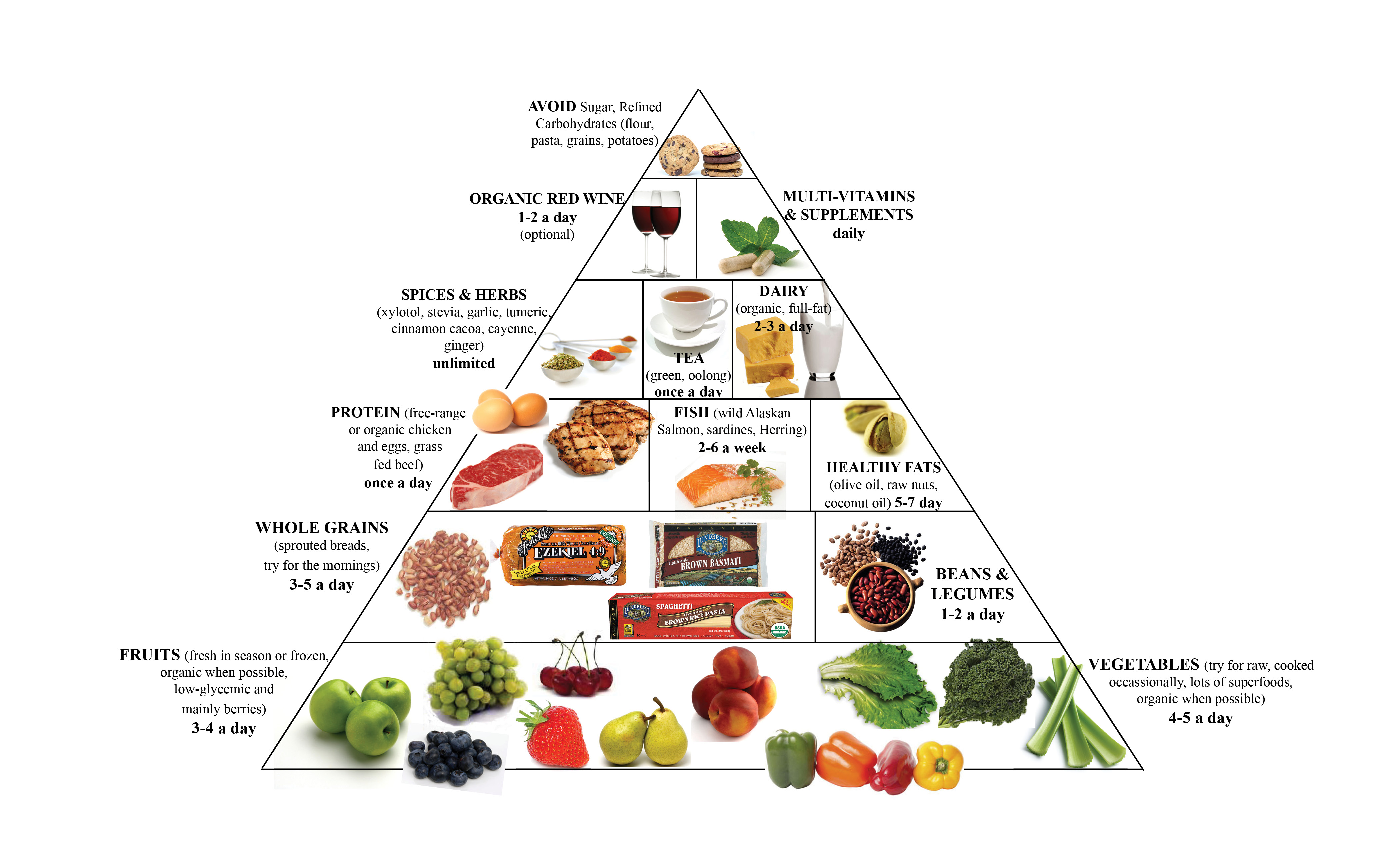
Last night I touched on briefly the Standard American Diet (acronym S.A.D.) emphasizing how many carbohydrates are included in the pyramid.  I do have a more relevant pyramid to my practices on file and did include it in this blog.  I must mention that this new diagram isn’t perfect.  It mentions 1-2 glasses of organic red wine per day and only one form of protein per day.  Contrary to this pyramid, more than 4 drinks per week can actually add chronic stress to the body so please keep this in mind.  In addition I’m firm that protein should be a part of every meal for it provides sustenance (‘feeling full’ for longer periods of time)and improves the recovery period for muscle repair (illness, tears, overuse). 

Food-Pyramidlike

Lastly, remember to add good fats to every meal: they’re an excellent source of fuel for the body and brain and per gram provide less calories than carbohydrates (for those calorie counters out there!). Healthy fats include: olive oil, raw nuts, seeds, coconut oil, avocados, coconut cream/milk, olives, etc.

Any questions or comments? I’d love to hear from you.

Be well,

Lynn

Mini homemade Larabars

This is one of the family’s favorite recipes. I love the recipe because it involves only a few pure ingredients and it takes less than five minutes to make. My family loves the mini bars because they are great to take skiing hiking or as a snack for school. They are gluten free, vegan and naturally sweetened with a fruit- no sugar, no substitutes. What’s not to love?

What you’ll need:
A vitamix, cuisanart or magic bullet.
Vanilla extract
Sea or Himalayan salt
Mold of some sort or press into a flat dish

Use any of these mixes:
1 to 11/2cup Cashews and dates (6)
Or
1 to 11/2cup almonds (or almond meal) and 1/2 cup cherries or raisins

Blend the dates or raisins first, then add the nuts a dash of vanilla and salt. If need be after mixing I’ll add a touch of water and mix with a fork to get a sticky but dough like consistency. Press into the mold and refrigerate.

Mini Larabars are ready for the taking. Enjoy.

Be well,
Lynn

20140101-121006.jpg